Our products are not OEM, they are only compatible parts


Beverage manufacturing relies on clockwork precision and seamless daily operations. However, recent OEM supply chain disruptions and extended lead times constantly throw wrenches into production schedules. These compounding delays directly threaten your Overall Equipment Effectiveness and plant profitability.
Procurement and maintenance directors face a challenging daily dilemma. You can wait several months for expensive OEM components and risk catastrophic, costly downtime. Alternatively, you can source alternative aftermarket parts and potentially risk equipment failure if components fall short of specifications.
This guide provides an evidence-based framework for navigating these specific challenges. We will explore how to confidently evaluate and integrate high-quality replacement components. You will learn to maintain line integrity, food safety, and maximum production speed while slashing lead times.
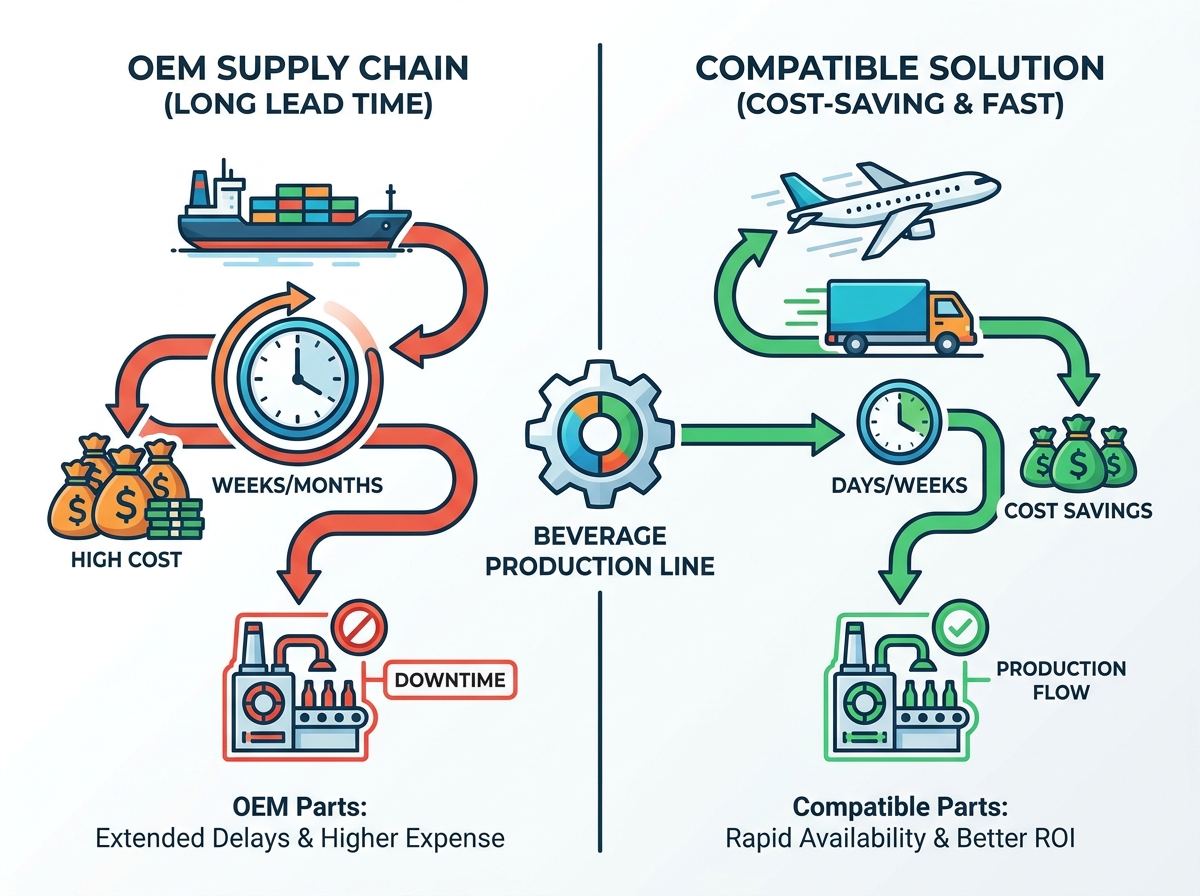
Extended OEM lead times are primarily driven by global supply chain bottlenecks and OEM focus on new equipment manufacturing rather than legacy part stock.
Precision-engineered beverage line compatible spare parts offer an exact-fit alternative that reduces procurement delays by up to 70%.
Evaluating alternative Tetra Pak AROL replacement parts requires strict adherence to machining tolerances, material certifications (food-grade), and performance guarantees.
A phased implementation strategy—testing non-critical components first—mitigates adoption risks and builds reliable internal procurement protocols.
An idle liquid filling or packaging line costs money every single minute. Waiting on a back-ordered OEM component triggers a massive downtime multiplier. Plant managers often overlook the cascading financial impact. We see direct labor costs wasted while operators stand by. You also face missed shipments, delayed retail deliveries, and severely strained client relationships. Furthermore, spoiled raw materials add heavy losses. If aseptic conditions fail during prolonged pauses, entire product batches go down the drain. You cannot afford to let an unavailable fifty-dollar seal halt a million-dollar operation. Common Mistake: Viewing downtime solely through the lens of lost production hours. You must also factor in raw material spoilage and expedited recovery shipping costs.
Unpredictable lead times force plant managers into defensive behaviors. They often over-stock expensive OEM parts to hedge against sudden shortages. This reactionary approach creates severe inventory bloat. It ties up crucial operating capital. Funds trapped on warehouse shelves cannot drive facility upgrades or support workforce expansion. Keeping excess inventory also increases storage costs. Rubber seals and specialized polymers often require climate-controlled environments. Parts degrade or become obsolete before technicians ever install them. This bloat represents an inefficient use of resources across the board.
Original equipment manufacturers operate under distinct business pressures. They frequently prioritize entirely new machine builds over legacy maintenance requests. We must objectively understand this OEM prioritization reality. Complex global logistics constantly slow down their distribution networks. When raw material shortages strike, OEMs route available stock to fulfill massive, highly lucrative new equipment contracts. Consequently, legacy replacement parts fall to the bottom of the production queue. This dynamic explains why your critical replacement requests suddenly face eight-to-twelve-week lead times. They prioritize capital expenditure projects over your operational expenditure needs.
We must clarify a critical industry distinction. True compatible parts are meticulously reverse-engineered. They match or exceed original factory specifications. Reputable engineers utilize advanced 3D scanning and precise metallurgical analysis. Conversely, cheap counterfeit knock-offs dangerously cut corners. Counterfeiters ignore strict tolerances and use inferior, non-compliant metals. Integrating beverage line compatible spare parts from verified vendors ensures safety. True compatibles provide exact-fit reliability. Counterfeits only introduce severe operational hazards and premature wear. Best Practice: Always request Material Test Reports (MTRs) before approving any new vendor to ensure authenticity.
Specialized aftermarket manufacturers operate completely differently than massive OEMs. They leverage leaner, localized supply chains. This agile manufacturing advantage allows for rapid production cycles. They quickly dispatch critical components like nozzles, seals, and specialized pump parts. Independent suppliers do not juggle complex new machine assembly lines. Instead, they focus purely on rapid aftermarket support. They pivot production schedules easily to meet urgent facility demands. You receive essential items in days rather than agonizing months. They utilize modern CNC machining to adapt rapidly to your needs.
Modern spare part suppliers utilize highly streamlined e-business platforms. They offer real-time SKU availability and straightforward ordering systems. This digital procurement transparency fundamentally improves the buyer experience. Procurement teams no longer wait days for simple email quotes. You log in, verify exact stock levels, and place orders instantly. Transparent inventory data eliminates second-guessing. It allows your maintenance departments to plan scheduled repairs accurately. Reliable data visibility keeps your entire operation running smoothly. Many modern platforms even integrate directly into your facility's maintenance software.
Food safety remains absolutely non-negotiable in beverage manufacturing. You must verify exact material compositions when evaluating alternatives. High-quality compatible parts use identical or superior food-grade stainless steel. They rely on FDA-approved polymers and highly hygienic finishes. Using improper metals invites rapid corrosion or harmful bacterial growth. Always request documented material certificates from your supplier. This paperwork guarantees regulatory compliance. It protects your brand reputation from devastating contamination events. Best Practice: Ensure elastomers use food-grade EPDM rather than standard commercial rubber for longevity in hot-fill environments.
High-speed cappers and aseptic packaging lines demand flawless precision. Sub-millimeter accuracy prevents catastrophic jams or sudden seal failures. Sourcing Tetra Pak AROL replacement parts requires strict verification of machining tolerances. Even a tiny micro-deviation causes excessive friction. Friction leads to premature wear and costly equipment breakdowns. Reputable aftermarket vendors offer explicit exact-fit guarantees. They confidently back their engineering. Their components drop into your assemblies perfectly on the first try. A variance of even 0.1mm can disrupt an entire aseptic packaging sequence.
Robust quality assurance separates reliable partners from risky vendors. You must scrutinize a compatible supplier's internal QA processes. Look for comprehensive Coordinate Measuring Machine (CMM) inspection reports. Verify their active ISO certifications. Ensure they maintain easily traceable manufacturing documentation. A transparent supplier invites you to audit their protocols. They hide nothing about their sourcing or testing methods.
Vendor Evaluation Criteria Comparison
| Evaluation Metric | Standard Counterfeit Vendors | Premium Compatible Suppliers |
|---|---|---|
| Material Certification | Rarely provided or easily forged | Full traceability and FDA compliance |
| Testing Protocols | Visual inspection only | CMM reports and stress testing |
| Facility Standards | Undisclosed manufacturing sites | ISO-certified modern facilities |
Plant managers constantly analyze the initial financial outlay against long-term durability. Compatible components often deliver an immediate 30-50% price reduction. However, true value extends far beyond the initial invoice. High-quality alternatives often outlast their OEM counterparts. Engineers can apply advanced surface treatments to enhance wear resistance. Sometimes they even correct inherent OEM design flaws. You gain immediate budget relief while maintaining exceptional lifecycle longevity. This balanced approach protects margins without sacrificing daily operational reliability.
We must frame rapid part delivery as a direct financial metric. Unplanned downtime drains thousands of dollars per hour. Eliminating these chaotic interruptions boosts your return on investment immensely. Rapid aftermarket availability prevents desperate emergency measures. You avoid paying exorbitant overnight shipping fees. You keep production schedules perfectly intact. Consistent availability stabilizes your operational budget. It effectively transforms procurement from a reactive panic into a predictable, manageable process. High availability directly elevates your OEE scores.
Many facilities operate highly mixed equipment fleets. Sourcing compatible parts across different brands creates immense financial benefits. It significantly reduces unnecessary vendor sprawl. You consolidate your purchasing efforts into fewer, more reliable channels. This standardization simplifies your entire procurement software ecosystem. Your accounting team processes fewer invoices. Your technicians memorize standardized installation procedures. Consolidating suppliers cuts administrative overhead. It optimizes your internal workflows remarkably and reduces training time for new mechanics.
Transitioning suppliers requires a calm, measured strategy. We recommend starting your transition gradually. Follow a logical phased rollout approach. Focus on high-wear, lower-risk consumable items first. This builds confidence among your maintenance staff.
Identify simple consumables like basic O-rings and standard bearings.
Test capping chucks on secondary packaging lines.
Analyze the wear rates over a standard 30-day cycle.
Transition cautiously to more complex mechanical assemblies like pump housings.
This careful pacing mitigates immediate adoption risks. It allows your maintenance team to build trust gradually. They learn the new supplier's quality firsthand.
Never test new components during peak production runs. Instead, schedule controlled installations during planned maintenance windows. Utilize scheduled Clean-In-Place (CIP) periods to swap components. This controlled environment allows you to monitor wear patterns safely. Technicians can measure performance metrics under strict observation. If an issue arises, they can revert to older components easily. Planned testing prevents unexpected mid-shift disasters. It provides accurate, stress-free validation of the new parts. Best Practice: Log all test data directly into your CMMS to track exact hours of successful operation.
Clear communication prevents costly misunderstandings. Advise your buyers to negotiate strict, transparent terms upfront. Demand comprehensive performance warranties before signing any agreements. Establish rigid return policies for any ill-fitting parts. Ensure robust technical support availability. A trustworthy supplier gladly embraces accountability. They stand firmly behind their products. Solid contracts protect your facility from unexpected financial burdens. Thorough agreements build long-lasting, mutually beneficial business partnerships.
Shifting away from exclusive OEM reliance represents a massive strategic shift. It is no longer just a localized cost-cutting measure. It has become an absolute necessity for robust supply chain resilience. Protecting your daily production schedule requires exploring diverse vendor options immediately.
Your success depends entirely on rigorous, uncompromising supplier evaluation. You must verify exact certifications, strict tolerances, and solid performance guarantees. Never accept vague promises regarding food safety or material compositions.
Procurement and engineering teams should audit their most frequently delayed OEM parts today. Contact a vetted compatible supplier immediately. Request a sample or trial component to benchmark performance on your line. Taking this proactive step secures your operational future.
A: Installing non-OEM parts generally does not void your entire machine warranty. It may affect coverage exclusively on that specific swapped component. Standard industry practices and local regulations heavily restrict OEMs from blanket warranty cancellations. Always review your specific service contract terms to ensure full compliance before making modifications.
A: Reputable engineers utilize comprehensive reverse-engineering processes. They deploy advanced 3D scanning tools to capture exact external dimensions. They conduct precise metallurgical analysis to match material compositions perfectly. Finally, they use state-of-the-art CNC machining to achieve the exact sub-millimeter tolerances required for seamless installation.
A: Yes, trusted suppliers use strictly regulated materials. They utilize CE-compliant and FDA-approved substances, including 316L stainless steel and food-grade EPDM rubber. Top-tier vendors eagerly provide full material traceability certificates upon request to guarantee compliance and protect your sanitary environments.
A: OEM parts often suffer lead times stretching between 8 to 12 weeks due to global bottlenecks. Conversely, specialized compatible suppliers typically dispatch standard components within 1 to 2 weeks. Delivery times vary based on part complexity and the supplier's localized inventory levels.
A: Established aftermarket vendors certainly can. They offer robust spare parts management systems tailored for enterprise operations. They frequently negotiate customized stocking agreements. This ensures multi-site beverage facilities enjoy guaranteed, rapid inventory replenishment without massive internal stockrooms.
