Our products are not OEM, they are only compatible parts


AROL capping machines hold a well-deserved industry reputation for high-speed reliability. Bottling plants worldwide depend on these robust systems to maintain relentless production schedules. However, this impressive throughput generates continuous mechanical stress on consumable components. Maintenance managers frequently encounter frustrating pain points on the factory floor. You likely face prolonged supply chain delays for OEM parts and persistently high replacement costs. Unplanned downtime strikes hard when capping arms or drivetrain elements unexpectedly fail, disrupting entire packaging lines. We designed this article to provide an objective, engineering-focused evaluation. It carefully compares sourcing high-quality compatible parts against relying solely on traditional OEM supply chains. You will learn specific analysis criteria for evaluating aftermarket capping arm seals, precision bushings, and plastic gears. By understanding material science and dimensional tolerances, you can stabilize production and maintain strict engineering standards without overspending.
Sacrificial Design is Intentional: Plastic gears and bushings are designed to fail first to protect expensive core drivetrain components; frequent replacement is expected, requiring a reliable parts pipeline.
Material Matching is Non-Negotiable: Compatible spare parts must match or exceed OEM material specifications (e.g., specific food-grade polymers, high-temperature elastomers) to ensure compliance and longevity.
Evaluating AROL Compatible Parts: Sourcing non-OEM parts requires vetting suppliers for dimensional tolerance validation, material traceability, and immediate stock availability.
High-speed packaging environments leave zero room for mechanical hesitation. Micro-stoppages kill line efficiency rapidly. Worn capping components cause subtle spindle misalignments. These minor errors compound into massive Overall Equipment Effectiveness (OEE) losses. Your production line might still run, but reject rates slowly climb. Crooked caps and improper torque applications force costly rework.
Engineers deliberately design certain components as sacrificial parts. Plastic gears and bronze or polymer bushings absorb operational shock. They wear out by design. They act as a mechanical buffer. The actual pain point is not the wear itself. It is managing the continuous procurement and replacement cycle. You must avoid creating production bottlenecks. Plant managers expect machines to run continuously. You need a robust strategy for consumable parts.
Sole-sourcing routine consumables from OEMs carries significant operational risk. You often face exceptionally long lead times for simple components. Manufacturers prioritize selling new machines over fulfilling minor spare parts orders. Minimum order quantities (MOQs) restrict your inventory flexibility. Premium pricing models drain your annual maintenance budget. Relying on a single supply channel leaves your facility vulnerable. Global supply chain disruptions can instantly halt your production. Diversifying your parts pipeline is a strategic necessity.
Capping machines operate in incredibly harsh physical environments. Friction, intense heat, and chemical exposure constantly degrade consumable parts. Cleaning in Place (CIP) and Sterilization in Place (SIP) procedures utilize aggressive washdown chemicals. Caustic soda and peracetic acid break down substandard rubber compounds rapidly. Furthermore, abrasive wear from PET plastic dust or aluminum cap shavings accelerates component degradation. Thermal expansion changes the dimensional footprint of seals during hot-fill applications. You must account for all these variables.
Evaluating third-party bushings requires strict engineering scrutiny. Dimensional tolerances are absolutely critical here. Micrometers matter for consistent torque application. A loose bushing causes spindle wobble. A tight bushing causes overheating and premature motor strain. You must demand self-lubricating material properties. High-quality bronze or advanced engineered polymers retain internal lubricants. We strongly warn against cheap alternatives. Low-quality bushings cause severe spindle misalignment. Compatible does not mean lower quality. It must mean exact engineering replication.
Food and beverage environments demand rigorous success criteria for seals. FDA and EU compliance is mandatory. A compatible seal must possess the identical durometer rating as the original. Durometer measures the physical hardness of the elastomer. If a seal is too hard, it fails to grip properly. If it is too soft, it shreds under rotational stress. Chemical resistance ratings must also match exactly. Your aftermarket supplier must provide certification proving the elastomer can withstand your specific washdown protocols.
Table 1: Common Failure Modes and Replacement Criteria for Seals and Bushings
| Component Type | Primary Failure Mode | Root Causes | Engineering Success Criteria |
|---|---|---|---|
| Capping Arm Seals | Cracking or Swelling | Aggressive CIP/SIP chemicals, extreme temperatures | FDA-compliant elastomers, exact durometer match |
| Spindle Bushings | Inner Diameter (ID) Wear | Abrasive cap dust, friction, lack of lubrication | Self-lubricating alloys, micrometer tolerance validation |
| O-Rings | Compression Set | Continuous mechanical pressure, thermal cycling | High-recovery polymers, verified chemical resistance |
Plastic gears serve a vital purpose inside the capping head. They act as a designed mechanical fuse. If torque exceeds safe operational limits, the plastic gear strips intentionally. This rapid failure saves the highly expensive metallic transmission parts from catastrophic damage. You want the gear to fail under stress. However, you want it to fail predictably. Unpredictable shearing causes random machine stops.
Evaluating an AROL compatible gear requires a deep understanding of polymer properties. Material science plays a defining role here. Manufacturers commonly use polymers like Acetal (POM) or Nylon for gear production.
Acetal/POM: Offers excellent dimensional stability and low moisture absorption. It performs exceptionally well in wet washdown environments.
Nylon: Provides superior impact resistance but can absorb moisture and swell over time.
Verification: You must verify the tensile strength and fatigue resistance of the chosen polymer. It must match the original equipment specifications exactly.
Manufacturing realities dictate the final quality of the gear. High-quality compatible gears undergo precise CNC machining. Machinists cut them from solid extruded polymer billets. This process guarantees tighter tolerances and superior structural integrity. Conversely, mass-produced cheap gears rely on injection molding. Injection-molded plastics suffer from cooling shrinkage. They often contain microscopic internal voids. These voids create unpredictable weak points. A molded gear might shear prematurely during normal operation.
Installation realities also demand perfection. Compatible gears must mesh seamlessly with existing OEM metal gears. Any deviation in the gear tooth profile causes immediate problems. Poor meshing generates excessive vibration. It accelerates wear on the connecting metallic components. Precision machining eliminates this risk entirely.
Table 2: Manufacturing Method Comparison for Plastic Gears
| Manufacturing Method | Tolerance Control | Structural Integrity | Ideal Application |
|---|---|---|---|
| CNC Machining (Billet) | Exceptional (Micrometer precision) | High (No internal cooling voids) | High-speed torque applications |
| Injection Molding | Variable (Prone to shrinkage) | Moderate (Risk of stress fractures) | Low-stress, non-critical components |
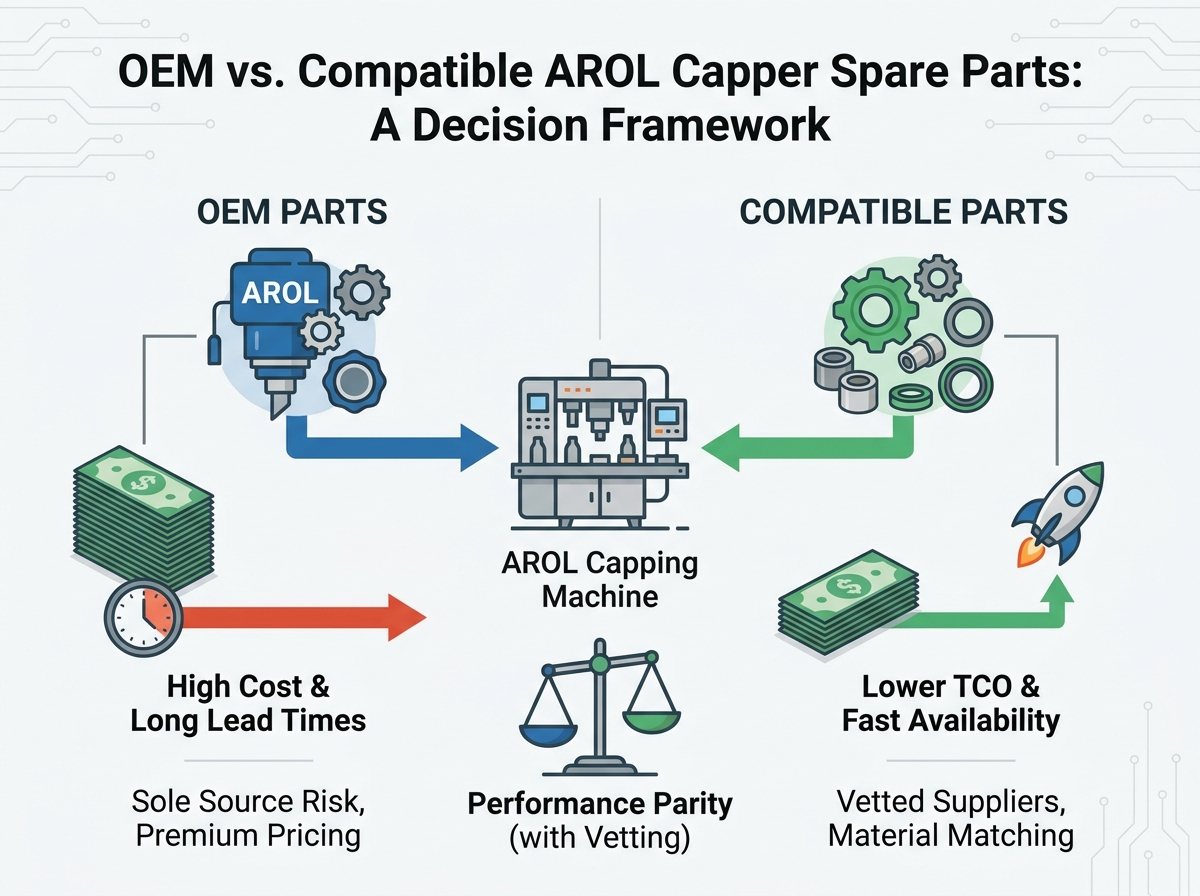
When procuring AROL capper spare parts, you must evaluate the complete lifecycle cost. Looking only at the purchase price provides an incomplete picture. You need a comprehensive decision framework. Calculate the lifecycle equation carefully. Add the initial part cost to the hidden lead time cost. Subtract the financial risk of potential failure. A premium OEM part offers perceived safety but carries high initial costs and lead times. A high-quality compatible part offers rapid availability and lower purchase costs. If engineered correctly, the risk of failure remains identical to OEM components.
Procurement teams need a concrete rubric for approving third-party manufacturers. Never buy critical components blindly. Follow this strict supplier vetting checklist:
Quality Management Systems: Demand current ISO certifications. Ensure the manufacturer follows standardized quality control protocols.
Reverse Engineering Capabilities: Request Coordinate Measuring Machine (CMM) inspection reports. These reports prove the supplier accurately measured the original part profile.
Material Traceability: Insist on Material Test Reports (MTRs). If operating in food environments, demand updated FDA or EC food-grade compliance certificates.
Address the primary fear directly. Maintenance managers fear equipment damage from aftermarket parts. You mitigate this risk through strategic vendor selection. Partner alongside specialized aftermarket machining companies. These firms employ dedicated mechanical engineers. They understand the physics of capping machinery. Avoid buying unbranded parts from generic catalog distributors. Generic distributors cannot guarantee material traceability or exact dimensional tolerances. Specialization guarantees reliability.
A smart inventory strategy eliminates shipping delays entirely. Maintain a strategic safety stock of compatible seals locally. Keep replacement bushings and gears in your facility tool crib. Localizing your consumable inventory buffers you against global supply chain shocks. When a machine goes down, your maintenance crew needs parts immediately. Waiting overnight for air-freight shipping destroys your daily production quota.
Move your operations toward data-driven part swaps. Reactive maintenance waits for a plastic gear to strip fully. This causes unexpected downtime mid-shift. Predictive scheduling relies on operational hours and historical wear data. Track exactly how many hours a capping seal lasts before failure. Schedule the replacement proactively during planned sanitation shifts. This approach maximizes line availability and reduces technician stress.
Change management requires careful documentation. Plant management often views aftermarket parts skeptically. Document the performance of newly sourced compatible parts meticulously. Run a structured 90-day trial phase. Monitor the reject rates, torque consistency, and wear patterns. Compare this data directly against historical OEM performance baselines. Prove the operational parity logically. Demonstrating concrete ROI and identical machine reliability easily wins executive approval for future aftermarket purchases.
Migrating to compatible spare parts for high-wear capping components represents standard industry practice today. Mature manufacturing facilities adopt this strategy to maintain competitive margins. The process works exceptionally well, provided your engineering vetting remains rigorous. You must prioritize material matching and dimensional precision above simple cost savings. By treating aftermarket procurement as an engineering challenge rather than a simple purchasing task, you protect your machinery and your budget simultaneously.
Take actionable steps immediately. First, audit your current annual spend on OEM seals, bushings, and gears. Calculate the exact financial cost of your lead-time delays over the past twelve months. Next, identify a reputable aftermarket machining partner. Request sample parts and comprehensive material data sheets. Install these test components on a single capping head and monitor the results over a defined period. This methodical approach builds confidence and establishes a highly resilient maintenance pipeline.
A: Standard industry practice dictates warranties typically cover the core machine framework. Using third-party consumables usually does not void the overall equipment warranty. However, specific OEM service contracts might contain restrictive clauses regarding aftermarket parts. Always check your individual Service Level Agreements (SLAs) before transitioning.
A: You must demand Material Test Reports (MTRs) directly from the supplier. Request technical data sheets detailing the specific polymer blend. This documentation ensures the supplier used the correct grade of Acetal (POM) or Nylon required for your machinery.
A: Yes, high-quality compatible seals are perfectly safe if manufactured using FDA or EC-compliant elastomers. Buyers must explicitly request official compliance documentation prior to procurement to guarantee chemical resistance during CIP/SIP protocols.
A: The lifespan is identical when properly sourced. If the third-party manufacturer correctly matches the dimensional tolerances and material composition—such as using self-lubricating bronze or specific engineered plastics—the compatible bushing will perform exactly like the original part.
